Visualizing 340,000 Bible Cross-References
When indexed by canonical coordinates, Scripture becomes a graph.
The Bible contains a vast network of cross-references connecting verses across books, authors, and centuries.
When indexed using canonical verse coordinates, these references form a structural graph spanning the entire canon.
Scripture becomes computable infrastructure rather than just text retrieval.
The visualization below renders roughly 340,000 cross-references as arcs connecting verses across the full sequence of Scripture.
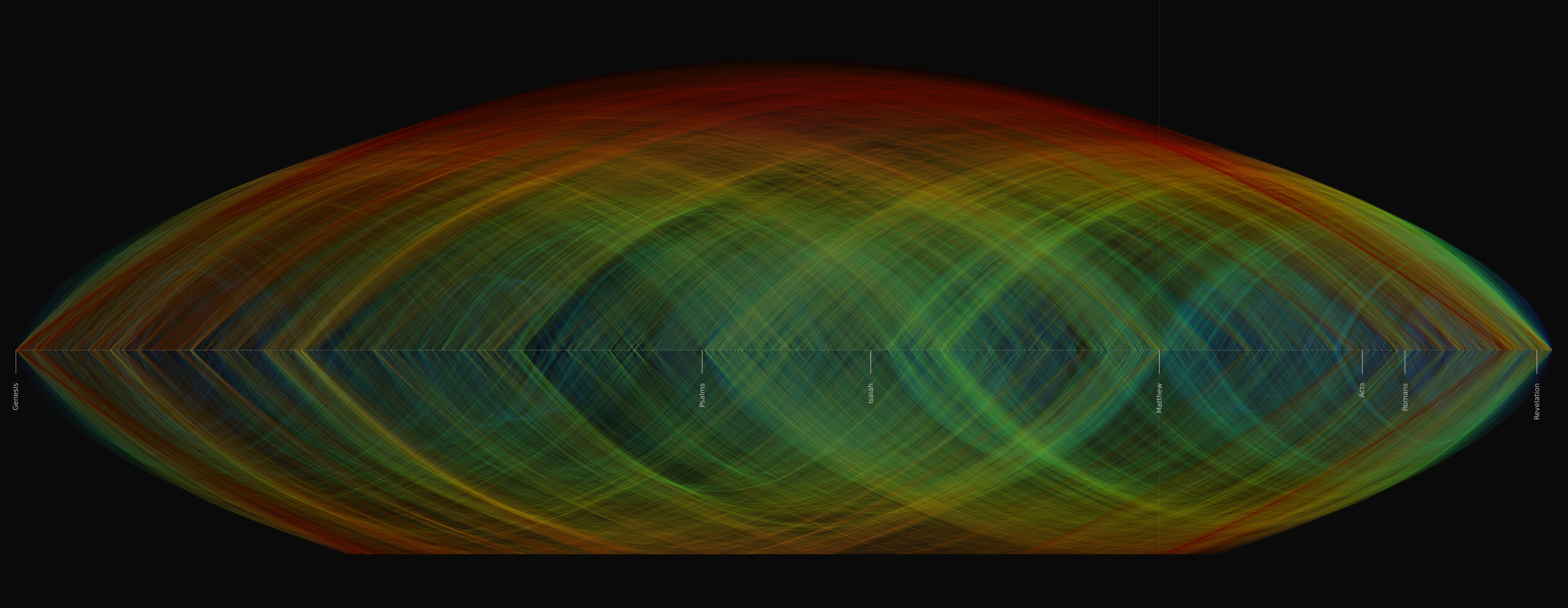
340,000 cross-references mapped across the canonical verse index (Genesis Revelation).
Arc color encodes the canonical distance between verses. Short references appear in cooler colors, while long-distance connections across the canon appear in warmer tones.
Each arc represents a relationship between two verses.
The horizontal axis represents the Bible indexed by a global canonical verse index.
Genesis appears on the left. Revelation appears on the right.
Cross-references are drawn as arcs connecting their corresponding verse positions.
Scripture as a Coordinate System
Most Bible APIs treat Scripture primarily as text.
A passage is retrieved by navigating a hierarchy:
- translation
- book
- chapter
- verse
That model works well for reading, but it makes structural analysis difficult.
BibleBridge introduces a canonical coordinate system where every verse has a stable global index:
verse_index: 1 31,102
This index allows Scripture to be traversed, measured, and computed as a continuous sequence.
Once references are mapped onto this coordinate system, structural relationships across the canon become computable.
- distance between verses
- reading windows
- cross-reference graphs
- structural clustering
Generating the Visualization
Each cross-reference pair is mapped onto canonical verse coordinates.
The process follows a deterministic pipeline:
Cross-reference dataset (OpenBible)
        ↓
OSIS reference pairs
        ↓
Canonical verse coordinate table (/slice)
        ↓
verse_index mapping
        ↓
Arc rendering
Because the coordinate system is version-agnostic, the structural relationships remain stable regardless of translation.
The visualization therefore reflects the structure of Scripture itself, not a particular edition of the text.
Patterns Visible in the Graph
Several structural patterns become visible once cross-references are mapped onto the canonical verse index.
- Dense clusters appear around the Psalms, reflecting their extensive quotation and reuse throughout later Scripture.
- Strong cross-canon connections emerge between the Old Testament and the New Testament writings, particularly around prophetic passages referenced in the Gospels and Epistles.
- The dashed vertical line marks the canonical boundary between the Old and New Testaments, revealing how frequently references cross it.
- Long-distance arcs connecting Genesis, Isaiah, and Revelation illustrate how themes introduced early in the canon reappear at the end.
Implications for AI Systems
AI systems working with Scripture face a structural problem.
Language models retrieve Bible text by reference string — but they have no way to reason about canonical position, proximity, or graph distance between passages.
When Scripture is represented as a coordinate graph, new capabilities become possible for AI pipelines:
- Rank verses by theological centrality using cross-reference density (
/cross-references+ weight scores) - Weight RAG retrieval by canonical proximity to a seed verse (
/cross-references+/distance) - Detect when two generated references are canonically adjacent or distant (
/distance) - Build Scripture-aware context windows that respect canonical structure (
/context+/cross-references)
These operations require a flat coordinate system. They are not possible with book/chapter/verse lookup alone.
Why Canonical Coordinates Matter
The visualization is possible because Scripture references can be converted into deterministic coordinates.
Without canonical normalization, cross-references remain unstructured strings.
With canonical coordinates, they become stable graph edges.
This enables new classes of analysis:
- cross-reference graph modeling
- verse centrality ranking
- structural clustering
- distance computation across the canon
Once Scripture is indexed using canonical coordinates, references become stable graph edges connecting verses across the canon.
This allows structural relationships between passages to be analyzed, traversed, and computed programmatically.
Structural Computation with BibleBridge
BibleBridge provides the canonical infrastructure required for these kinds of structural operations:
- Thematic cross-reference lookup (
/cross-references) — returns the pre-computed cross-reference graph for any canonical verse, ranked by attestation weight, with strength tiers (very_high,high,medium,low) - Reference normalization (
/resolve) - Verse coordinate expansion (
/expand) - Sequential traversal (
/slice) - Canonical distance computation (
/distance)
These endpoints allow Scripture-aware systems to operate on deterministic structural coordinates rather than fragile text parsing.